

Mirror Box Podcast Ep8 - Study Up: Exploring the Importance of Supporting Characters
This month, Alex and Monica do another historic walk through the world of supporting characters, what roles they play in film and literature (hint: they’re important), and teach us some new words along the way.
This month, Alex and Monica do another historic walk through the world of supporting characters, what roles they play in film and literature (hint: they’re important), and teach us some new words along the way.
Now available on…
Mirror Box Podcast Ep6: Study Up: How Horror Films Adapt To Societal Fears
This week Alex and Monica walk us through a deep dive of the 90 year history of horror films and how they adapt to and reflect the fears of society as a whole.
This week Alex and Monica walk us through a deep dive of the 90 year history of horror films and how they adapt to and reflect the fears of society as a whole.
Now available on…
Mirror Box Podcast Ep5: Adaptation
Hudson & Sonya deep dive into all facets of ADAPTATION- from their favorite book-to-film adaptations (and what makes them great), to learning how to follow their filmmaking dreams while adapting to their environmental life changes.
Hudson & Sonya deep dive into all facets of ADAPTATION- from their favorite book-to-film adaptations (and what makes them great), to learning how to follow their filmmaking dreams while adapting to their environmental life changes.
Now available on…
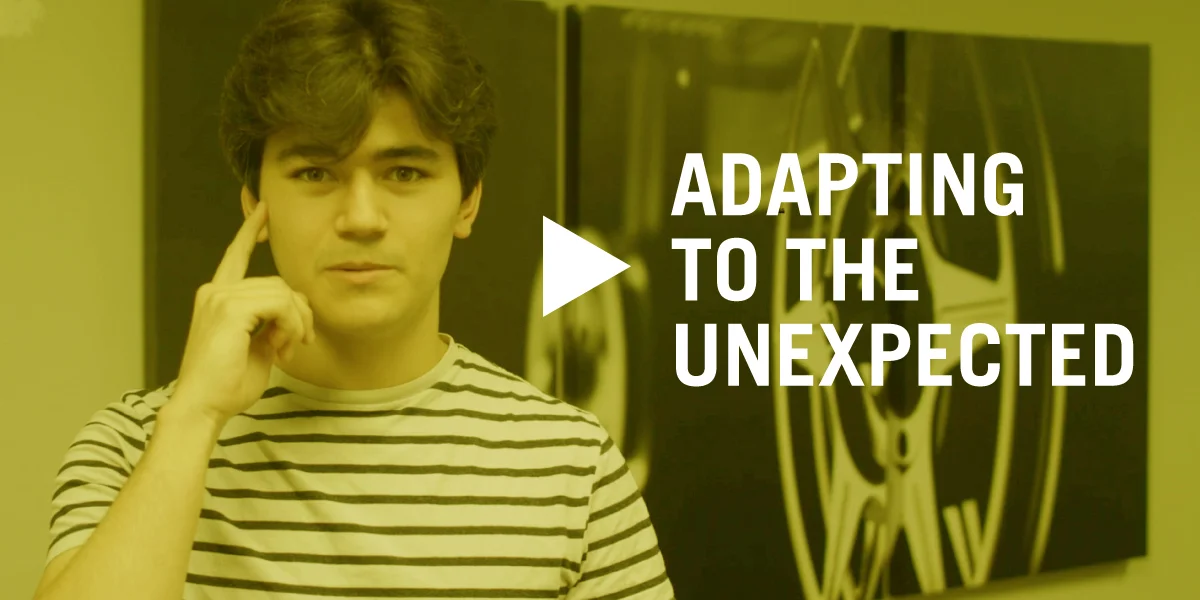
Adapting To The Unexpected (VIDEO)
No matter how well you prepare for it, problems will always pop up when making a film on any budget level. Filmmaker Adam Petrey walks you through some of the lessons he learned shooting his micro-budget shorts and the creative problem-solving needed to adapt to the unexpected.
No matter how well you prepare for it, problems will always pop up when making a film on any budget level. Filmmaker Adam Petrey walks you through some of the lessons he learned shooting his micro-budget shorts and the creative problem-solving needed to adapt to the unexpected.
TRANSCRIPT
1. PLAN AHEAD
“The enemy of art is the absence of limitations.”
- Orson Welles
You’ll never be able to know exactly what will go wrong but with careful planning you can limit a lot of mistakes. Double check your equipment. Have a well-planned story board and shot list. Rehearse with your actors and crew before you get on set and communicate with them efficiently and don’t waste time on set.
Having a well-laid plan is important and will help you be more flexible when you inevitably have to change it. Don’t be afraid to change things on the fly or throw away the plan entirely if the situation demands it. Use your best judgement and never let pressure get the best of you. You should always be leading by example.
“A lot of times you get credit for stuff in your movie that you didn’t intend to be there.”
- Spike Lee
I have directed short films where half-way through filming I realized we weren’t going to make our day and were way behind schedule. I pulled aside my DP into another room away from the rest of the crew and basically threw away our shot list and began combining and condensing shots together and ended up getting fantastic shots I never expected.
Sometimes problems can be a blessing in disguise because in the moment everything falls away leaving what is truly crucial to telling your story.
2. TRUST OTHERS
You may have heard “If you want a job done right, you’ve got to do it yourself” but this doesn’t apply to film. Collaboration and teamwork are essential to filmmaking. You can’t do it on your own. You have to find hard-working people you trust to be on your team and treat them with Respect.
“Filmmaking is the ultimate team sport.”
- Michael Keaton
You may not know anyone working in film but there are resources online to cast actors, collaborate with writers, find crew members, and more. If you know someone interested and willing to help out without experience, train them on the various aspects of film.
“I think at the end of the day, filmmaking is a team, but eventually there's got to be a captain.”
- Ridley Scott
Remember to always be appreciative of those around you and to never lose sight of your vision. A great project and good leadership will help keep moral high. Always be kind and never let yourself get caught up in the stress of completing a project.
Remember making movies is fun and it’s even better with friends.
3. KEEP IT SIMPLE
Everyone wants to make the next great sci-fi epic but that doesn’t mean you have to overdo it. You can create genre-films on a low budget you just have to get creative. Many of our biggest filmmakers started with heavy genre pieces.
Instead of dealing with the sweeping landscapes and wide scope of high genre works you single out one very interesting detail and do it to the best of your ability. Such as using makeup or prosthetics to create an alien that is found in someone’s backyard or whip up some fake blood for a scene.
Know your limitations, but create the films you want to make!
When dealing with prop weapons in film experiment with things other than guns which are hard to pull off because it’s hard to find a decent replica and visual effects are hard to pull off in a realistic manner.
“With no-budget films, guns don’t work very well, because you can never get the right replica gun, it’s never got the weight to it, and you can’t fire blanks.”
- Christopher Nolan
Maybe instead of an epic shoot-out, you could use weapons such as hammers, baseball bats, and knives which can look way better than a cheesy muzzle flash from a toy gun. Play around with unique objects and see what you can dream up.
4. DON’T FIX IT IN POST
Anyone who has spent enough time on a film set has heard the phrase “We’ll fix it in post.” Nine times out of ten, it’s not going to work.
Some things will never be able to be fixed no matter how much expensive software you own because you didn’t film it correctly when you were on set.
Make sure you get all the shots you want. You’ll thank yourself in the editing room. Don’t leave a scene until you’re happy with what you have. While it may be hard to convince a tired crew to do one more shot it will be worth it in the end.
Especially when it’s not within your budget to schedule reshoots and insert shots to cover up and fix your mistakes it’s important to make sure everything is right.
The audience doesn’t care what excuses you have.
Something that I always try to keep in mind whenever things get tough is that “Pain is temporary but film is forever.”

Mirror Box Podcast Ep4: Writing Diverse Characters
Alex and Monica explore the topic of writing characters with identities different than your own, focusing on tropes to avoid when developing the characters and how to research these identities in order to portray them most accurately.
Alex and Monica explore the topic of writing characters with identities different than your own, focusing on tropes to avoid when developing the characters and how to research these identities in order to portray them most accurately.
Now available on…

How To Start A Writer's Group with Pepper Reed
Pepper Reed gives insight on the writing groups she’s currently a part of, what she loves about them, and even how to go out there are start your own!
I first met Pepper Reed through the online screenwriting group I run, ScriptBlast, and was quickly inspired by Pepper’s focused productivity. She let me in on the secret that a big part of her consistency is due to the fact that she’s part of not one, but two writing groups who inspire her and hold her accountable. I’m a big believer in community and these kinds of groups should be a requirement for every writer. If for no other reason, then for the power of knowing YOU’RE NOT ALONE. I thought it’d be a great idea to chat with Pepper all about HOW TO START YOUR OWN WRITER’S GROUP.
Tell us about your writing journey and the writer's groups you're involved in right now.
I started writing my first script in college. It was never finished, but there are still things in it that I come back to. I was an actor then. Later I wrote a short that turned into my first feature after I left LA and moved back to Oklahoma.
I stopped writing for a while. I was trying to figure out how to get into the industry and move towards my goals. I started script supervising for indie films and shorts. That’s when I really started writing. By the time I moved back to LA last February, I had drafts in various stages for seven features, two shorts, and a pilot already written. I’d also written the script for a music video I directed. I had a couple of people who would read my work and give me notes, but part of the point of moving was to kick everything into high gear.
I’m currently in two writers groups. The first one I started about two months after I moved to Los Angeles last year. The second one I just joined a month ago. Both groups are all women. With the first group, that was just how things worked out. I had posted in several groups (on Facebook and Google) that I’m a part of looking for a group to join and couldn’t find one that worked the way I wanted it to, so I created my own. Then I posted in the same places asking if anyone wanted to join. It ended up that only women responded.
The second group was organized by a local women’s tv writers organization in LA. They help women who want to write for TV. This group is interesting because we all write genre pieces, i.e. Sci-Fi or Fantasy.
I usually have a several scripts going at once. Currently, I have my spec. I just finished revisions based on notes from both of my groups and so it is basically done, but I might add a snarky line of dialogue or two before I submit it. I have a short which is going to be shot in March, so it is done, but then an actor might give me a comment, so it could have a change. I have a pilot that has been to one writers group but not the other. It’ll go out later this week and I’ll have a rewrite after that. I have another pilot idea that I’m thinking on and will write once I’ve submitted the other to the fellowships. Finally, I have a feature which has had two full drafts, but needs a good rewrite. It has been marinating on the back burner for a few months and is about ready for me to stir things up as soon as these fellowship applications are done.
Some people don’t work this way, and I can completely understand. For me though, it helps. One day I can work on my spec, then next my feature. And if I’m blocked or having trouble with one project, I can move over to another one for a little while and take the pressure off.
Why is it important to you to be a part of a group?
I wanted a writers group so I was getting notes from people who worked in the industry. Reading scripts regularly and learning how to give and receive notes is incredibly important. Plus there is the added benefit of having built in deadlines. With my first group, we know well in advance when our turn is coming up.
How do they work? How often do you meet? What's an average group like?
I was surprised that I had to create a group myself. I wanted a group that would meet once or twice a month and we would read one of the members’ entire script in advance of the meeting and give notes at the meeting. Most of the groups I found in LA, you would bring in 5 to 10 pages and people would read them right then and give notes. I didn’t find that helpful. If you need accountability to make sure you do your work, yes, but I don’t have that issue.
Both of my groups meet every other week, one on Mondays and one on Thursdays. We send our scripts to the group a week in advance to give everyone plenty of time to read them and make notes. We talk about what we’re working on, exciting meetings, events we are going to, finding scripts for episodes of shows we want to spec. A lot of the talk at the moment is about the TV writing fellowships. We give our notes to the person whose script is up and then, if they have questions, they ask those.
What's the biggest benefit you've personally gotten out of the groups?
This industry is really about relationships, but a lot of writers are introverts. It’s much easier to get to know people when you are in a smaller group (some of those networking events are insane) and you have a built in topic of conversation. I’ve made some really good friends, which can really be a challenge, especially in a city like LA.
You're part of an all women's writers group and an all genre (sci-fi/fantasy/horror) writers group. Do you find a deeper connection in these kinds of like-minded groups?
My Sci-Fi/Fantasy group got references and Easter eggs that I’d written into my Lucifer spec, which my other group didn’t get, but I get great notes in both. And since both groups are all women, I think they can push me to go deeper. I know that their comments are coming from their own experiences as women.
I write for the girl that I was growing up. When I was young I didn’t feel like I fit in anywhere. I was an outsider. But I connected with characters in the books I read and in the films and tv show I watched. Now, I use paranormal and fantasy characters as a metaphor for “the other.” If you can connect with a vampire, if you can empathize with a werewolf, maybe that can help you understand your neighbor who doesn’t quite fit in. Having a group that understands and enjoys these metaphors can be helpful when they might read a script multiple times, since my Sci-Fi/Fantasy group is about half the size as my original writers group.
What is it about genre film & tv that draws you to it?
I love being able to see inside people minds. Film and television are visual adaptations of imagination. We are painting the screen with light and color, in some cases, ideas that were originally imagined hundreds of years ago.
What tips do you give for starting and/or running a successful writers group?
Make sure that the people who are joining want the same kind of group you want. When I was first looking, I had posted a very clear “ad” but people kept coming back to me saying they were interested but would then describe a group like all the ones I didn’t want.
I’ve met with most of the members individually as well as with the group, just to get coffee and chat. When I started my first group, I knew one of the women and had met one of the others. Everyone else was a complete stranger. We meet at my apartment most of the time now, but in the beginning we met in a public space.
As for keeping it going, my first group made it through a summer break and a winter hiatus for the holidays. I’d say be very specific about when you’re taking the break and for exactly how long. Know in advance who is up when you get back, otherwise, things will fall apart.
You can follow along with Pepper’s writing journey on Instagram at @pepperreed .

Finding Your Creative Identity (VIDEO)
There is a lot of pressure to demonstrate your originality and many times leads to artificial projects made to please others. In this video, filmmaker Adam Petrey discusses ways to stay true to yourself and how to develop your own creative identity while living your life to the fullest.
One of the most important aspects of being an artist is self-discovery. The journey of finding out what you have to say about the world and how you're going to say it. There is a lot of pressure to demonstrate your originality and many times leads to artificial projects made to please others.
While filmmaking requires a great deal of self motivation we should never feel alone in the process. Always surround yourself with a community of people that lift you up and motivate you to do your best. In this video, we'll discuss ways to stay true to yourself and how to develop your own creative identity while living your life to the fullest.

Mirror Box Podcast Ep2 — Study Up: How to Start a Podcast
Monica Beard and Alex Oakley host a new monthly segment called "Study Up" where they'll take one topic surrounding our monthly theme, go out and explore it, and come back and report about what they learned. This week, they tell us how they started their first podcast.
Monica Beard and Alex Oakley host a new monthly segment called "Study Up" where they'll take one topic surrounding our monthly theme, go out and explore it, and come back and report about what they learned. This week, they tell us how they started their first podcast, Shot for Shot, and the lessons they learned along the way that apply to anyone beginning a new creative endeavor.
Now available on…

How (and why) to Organise a Table Read for your Screenplay
Writers—stepping away from your laptop-induced solitude and connecting with people is good for you in general. And you want to be sharing your work with peers, getting valuable feedback, and highlighting weaknesses. Taking advantage of table reads and hearing it read aloud will do that in a way that reading it in your head can’t.
So You’ve Begun Organising a Screenplay Table Read?
Firstly - great idea. Stepping away from your laptop-induced solitude and connecting with people is good for you in general. And you want to share your work with peers, get valuable feedback and highlight weaknesses and hearing it read aloud will do that in a way that simply reading it in your head can’t.
My table read journey
On the February 21st, the International Moving Image Society, whose Screenwriting Community I am the Leader for, hosted the winners of their Screenplay Table Read Competition “Out Loud” in London. It brought together stunning writing and acting talent for a magical night of varied writing styles and genres and the feedback we had from the audience and participants was very positive.
This event was also the culmination of my own journey as a Screenwriter and using table reads as a development tool. Some of my own table reads have been phenomenal and some have been what they call “learning experiences.”
So, based on this, here are some of my thoughts before you begin, to help you get the most out of the exercise:
What is your objective?
If you want to showcase it to the industry, then what you may need is something closer to a Rehearsed Reading – that’s a different thing to what we discuss here. If it is purely a development exercise, then a Table Read is indeed what you need, read on!
What is it?
Some types of writing do better than others in a Table Read format – if it’s lighthearted, certainly comedy, snappy dialogue-driven, light on the action description, then this will fare the best. Similarly, character-based drama will get actors really enthused.
However, if your script is not that type of writing, if it is a heavy tone, or contains lengthier action description - as in a thriller, or a fantasy world, or is mind-bendingly high concept, it might feel turgid no matter how good it actually is - simply because the Table Read format does not suit it. Don’t let that deter you from this exercise, just understand that Table Reads lend themselves more to some types of writing and not others.

Photos: Alastair Searles
Set the tone
Even if your writing is clearly of a darker nature, sometimes the energy of the occasion will kind of force it into a lighter, sometimes even silly tone, because when people gather, they naturally want to have a good time. Nothing wrong with people having a good time, but the focus needs to be primarily on work and highlighting flaws in the script with a forensic accuracy.
Therefore, make sure you give a good introduction to the Actors that includes the tone of the piece, and make sure you give each actor a good steer on the character.
I’ve made this mistake before – giving the actors as little possible because I felt that the type of material should really leap off the page and guide them. Maybe this was my ego. And sometimes I was right, they didn’t need guidance, but sometimes they really did. One time an Actor went off on such a wrong tack, that it undermined the whole exercise.
Is it part of a Writing Group?
An advantage of a writing group is it can give you access to a ready network of people who give great feedback. Unfortunately, it can also give you access to - *real talk now* - fellow writers who give derailing, self-indulgent or inaccurate feedback, including those who are actually working TV or film writers. In a group, you can’t decide who turns up to give this feedback, so if you have a group in mind, but they haven’t seemed sufficiently constructive in previous sessions, my advice is to move on to a different group or organise it yourself.
The other advantage of a writing group is that they have a ready set up location, which of course means the disadvantage is you don’t get to choose it. If it’s in a pub or restaurant, it puts it in a social occasion feeling and you may have to contend with all sorts of distractions and interruptions, such as people drinking or having the food they ordered delivered, or barman changing keg, (all of these have happened to me, best thing to do is laugh it off).
You might be better off organising it in a classroom-type venue, or even at someone’s house, if they can accommodate it.
Cost
Even if part of a group - so presumably no need to pay for the venue - the cost can be quite high. Even if you have people read the script from a tablet, you will have to have printed scripts on hand as back up. It also may be an unwritten rule you buy the Actors a drink. Last time I did this I spent £80, which starts getting very high. Factor this in from the beginning.

Photos: Alastair Searles
Casting
Obviously you’re going to cast those who can play the role the best, however, two things to consider:
The Narrator – many Actors won’t want to do this thankless role, or may be tempted to bring a “performance” to what should be a neutral-ish reading. You might better off with a non-Actor who is a good sight-reader. I had this experience with a Vampire script of mine where the Narrator happened to have a great, rich, Donald Sutherland-esque voice. This happy accident transformed what could have been an awkward Skype-read into a really positive experience.
Don’t read anything yourself, including the narrator, if you can possibly avoid it. You need to be sitting, listening, taking notes, making sure your iPhone is still recording it.
Some final suggestions
Read it straight through with no break – it is useful to note if people become restless and if it holds attention till the end, this will help demonstrate if the script has been “built” well. It can be gruelling, but is ultimately, very helpful.
And don’t trim the narrative for the purpose of the table read. Again, if there are editing opportunities, then a table read is a good way of highlighting these, don’t pre-empt where any cuts could be made because you want people to have a good time. This is about your script.
Conclusion
Take control. At one Table Read of one of my scripts, the only bad performance was from an actor who asked me to be in it. All of the other actors were ones I approached and they all gave great performances. That taught me that I have to take complete control of the whole process to get the most out of it, because if one element is wrong, performance, venue or whatever, then it can undermine the entire process.
And if you do have a negative experience with a table read, don’t let it, as a tool, deter you. Learn from it for next time, as I did in the lead up to the Table Read event I hosted for the International Moving Image Society.
CLICK HERE to learn more about the IMIS Screenwriting Community!

The Long Road to "Yes:" My First Short Film as Director
I think I first realized that such a thing as a director existed when I was 14 years old. The nasty voices immediately started in my head: “Only old white men get to do that fun stuff. Like Scorsese and Coppola and George Lucas. Not women. Especially not tiny hijabi Sri Lankan Muslim women from Dubai.”
My first short film – finally!
I think I first realized that such a thing as a director existed when I was 14 years old. The nasty voices immediately started in my head: “Only old white men get to do that fun stuff. Like Scorsese and Coppola and George Lucas. Not women. Especially not tiny hijabi Sri Lankan Muslim women from Dubai.”
But I still couldn’t shake that feeling. That I was meant to be doing that thing. That Scorsese and Coppola and Lucas were doing.
I had been a quiet introverted ‘writer’ up until then – a writer of tortured poetry, weird plays and much angst-ridden short stories.
Because the world around me told me ‘no, you’re not allowed’, I stayed that way for about 15 years. Give or take a year.
Then #metoo happened. Then four rejections happened in quick succession. Each one hurt worse than the others because all I needed was for one person to say yes.
Then I thought to myself, “Why don’t I say yes… to myself? Who has the right to tell me that my story isn’t valid?”
Answer: no one. Not even me.
After one traumatic childbirth experience, the death of my mom, three company (read: family) moves across three countries, I’ve realized that life is short. What’s the worst that could happen? Nothing will kill me except, you know, death.
I am terrified. So so terrified. My anxiety disorder is LOVING this. My depression just waits for those rejections so it can tell me just how ‘not good enough’ I am (they’re both wrong, but I love them anyway).
But here I am, on this director’s journey at last. And I have to say, my dear friends – I feel more alive than I’ve ever felt. Good God, it hurts, but it’s a good kind of pain.
Early last year, I made an 8-minute short called I Like Long Walks. One location (my house), one character (me), minimal set ups. We're currently tightening it up in post and hoping to submit it to a few festivals. Watch this space.
Here are a few lessons I learned from this teeny tiny but mighty experience.
Food rocks. Food is super important. Food is the wind beneath my wings. (I'm fasting.) Seriously though: Plan lunch in advance in consultation with your crew. If you're going to do French hours i.e. no lunch, have tons of healthy and nutritious snacks on hand. Again in consultation with your crew. I had precisely one other person so that consultation would have been easy. If I had done it. And have lots of water on hand.
Get help. I was so overwhelmed writing, directing, producing and starring that I failed to account for pretty basic needs (see above).
I was initially planning to shoot the thing myself so I did not feel the need to do a recce with sound and light in mind. If I had, I'd have known the train and the highway right outside would be rather a bother for sound. Plus my loud neighbors and their ludicrously long home improvement projects. I had also initially wanted to shoot in my bedroom. But light is terrible there. So we chose the living room but light fluctuates like crazy where I was sitting. It all made for fun times in post.
Take your time on set. Goodness takes time. Especially when your actor (me) has not had a lot of sleep and is acting out some tough emotions.
Divide your script into units even if there aren't any scenes. So this makes it easier to shoot and easier to edit as well.
Make sure sound is rolling when camera is rolling and off when camera is off. It can make for irritating work in post listening to sound files looking for the correct audio. Label sound files with scene numbers.
Choose people to work with who are generous with their knowledge. Who don't laugh at you when you ask questions. Who teach you everything they can. Because personally, I learn best from other people
A true spirit of collaboration is key. No creative should dominate the conversation, should drown someone out, should muscle in, negate or ignore any other. Empathy and being a good listener are SUCH PIVOTAL QUALITIES for a good filmmaker, it's ludicrous. I would highly recommend reading Marshall Rosenberg's Non Violent Communication. The whole book seems to be up here for free with seemingly no copyright claims.
This is where directing overlaps with mothering to a great degree - the director directs the vision of the film. What that means to me is: Directors set the most gentle parameters they can and then allow their people to play freely within those parameters. Those gentle parameters are key, I think.
Keep the props in a safe place in case you need to reshoot!
Hope this helps. If it is in your heart to do so, go out and make movies, folks. Nothing quite like it. I always knew this. But I'm only accepting this truth now. Better late than never, I guess.